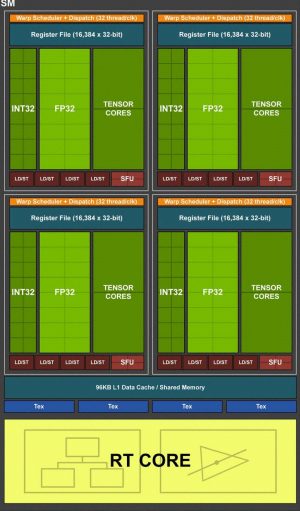
Being so crucial to their achievement, NVIDIA is not disclosing many details about the RT Cores or their BVH implementation. Of the details given, much is somewhat generic. To reiterate, BVH is a rather general category, and all modern raytracing acceleration structures are typically BVH or kd-tree based.
Unlike Tensor Cores, which are better seen as an FMA array alongside the FP and INT cores, the RT Cores are more like a classic offloading IP block. Treated very similar to texture units by the sub-cores, instructions bound for RT Cores are routed out of sub-cores, which is later notified on completion. Upon receiving a ray probe from the SM, the RT Core proceeds to autonomously traverse the BVH and perform ray-intersection tests. This type of ‘traversal and intersection’ fixed function raytracing accelerator is a well-known concept and has had quite a few implementations over the years, as traversal and intersection testing are two of the most computationally intensive tasks involved. In comparison, traversing the BVH in shaders would require thousands of instruction slots per ray cast, all for testing against bounding box intersections in the BVH.
Returning to the RT Core, it will then return any hits and letting shaders do implement the result. The RT Core also handles some grouping and scheduling of memory operations for maximizing memory throughput across multiple rays. And given the workload, presumably some amount of memory and/or ray buffer within the SIP block as well. Like in many other workloads, memory bandwidth is a common bottleneck in raytracing, and has been the focus of several NVIDIA Research papers. And in general, raytracing workloads result in very irregular and random memory accesses, mainly due to incoherent rays, that prove especially problematic for how GPUs typically utilize their memory.